What makes cleanroom HVAC different
A comfort air conditioner holds temperature within a few degrees and lets humidity drift. A cleanroom holds temperature within ±1°C, relative humidity within ±5%, a defined pressure cascade between adjacent rooms, and a particle count below a class limit — all at once, all day, every day.
Fail any one of those and you risk product integrity, batch rejection or a regulatory finding. The HVAC is not a utility in a cleanroom; it is part of the process.
Pressure cascade and airlocks
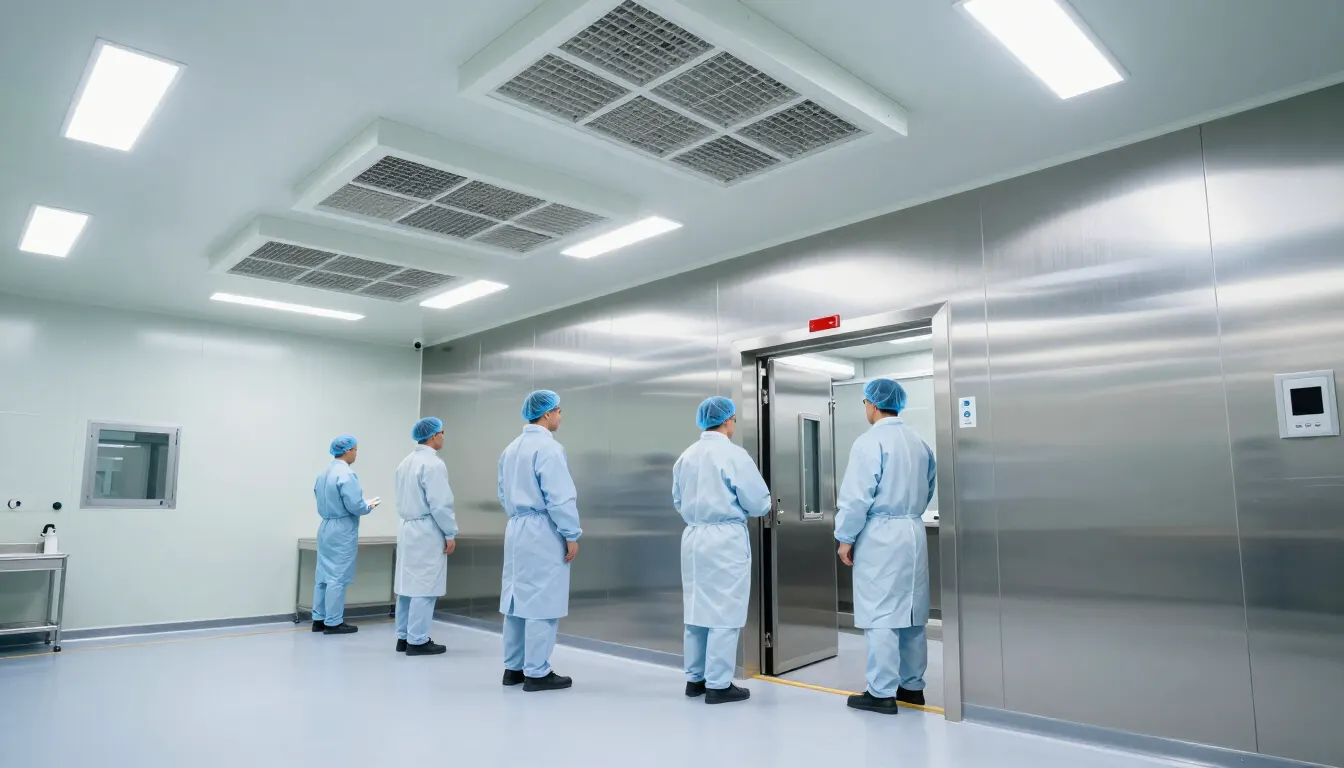
Cleanrooms are protected by pressure differentials. A higher-grade room is held at a higher pressure than the corridor next to it, so air leaks out (not in) when a door opens. For toxic or biological work, the cascade reverses to negative pressure so contaminants stay inside.
Airlocks break the path between zones of different cleanliness. The HVAC must be sized and controlled to maintain the differential across every door cycle, not just at steady state.
Filtration and air changes
Terminal HEPA (or ULPA for the tightest classes) filters supply the room. The air-change rate sets how quickly particles are flushed — higher classes need more changes per hour, which means more air, more fan power and more cooling. Right-sizing the air-change rate is where energy and purity trade off.
Every HEPA installation is integrity-tested (DOP/PAO) before handover and at scheduled intervals afterwards.
Qualification: IQ, OQ, PQ
A cleanroom is not “done” when it is built. It is done when it passes Installation, Operational and Performance Qualification — documented evidence that the room meets its design spec under real operating conditions, including particle-count mapping at rest and in operation.
We deliver full IQ/OQ/PQ documentation with every cleanroom build so your validation team has what it needs for audit.
Want this for your site?
Talk to a Head On Solutions engineer about your HVAC project — fixed pricing, ISHRAE-member crews, written warranty.